
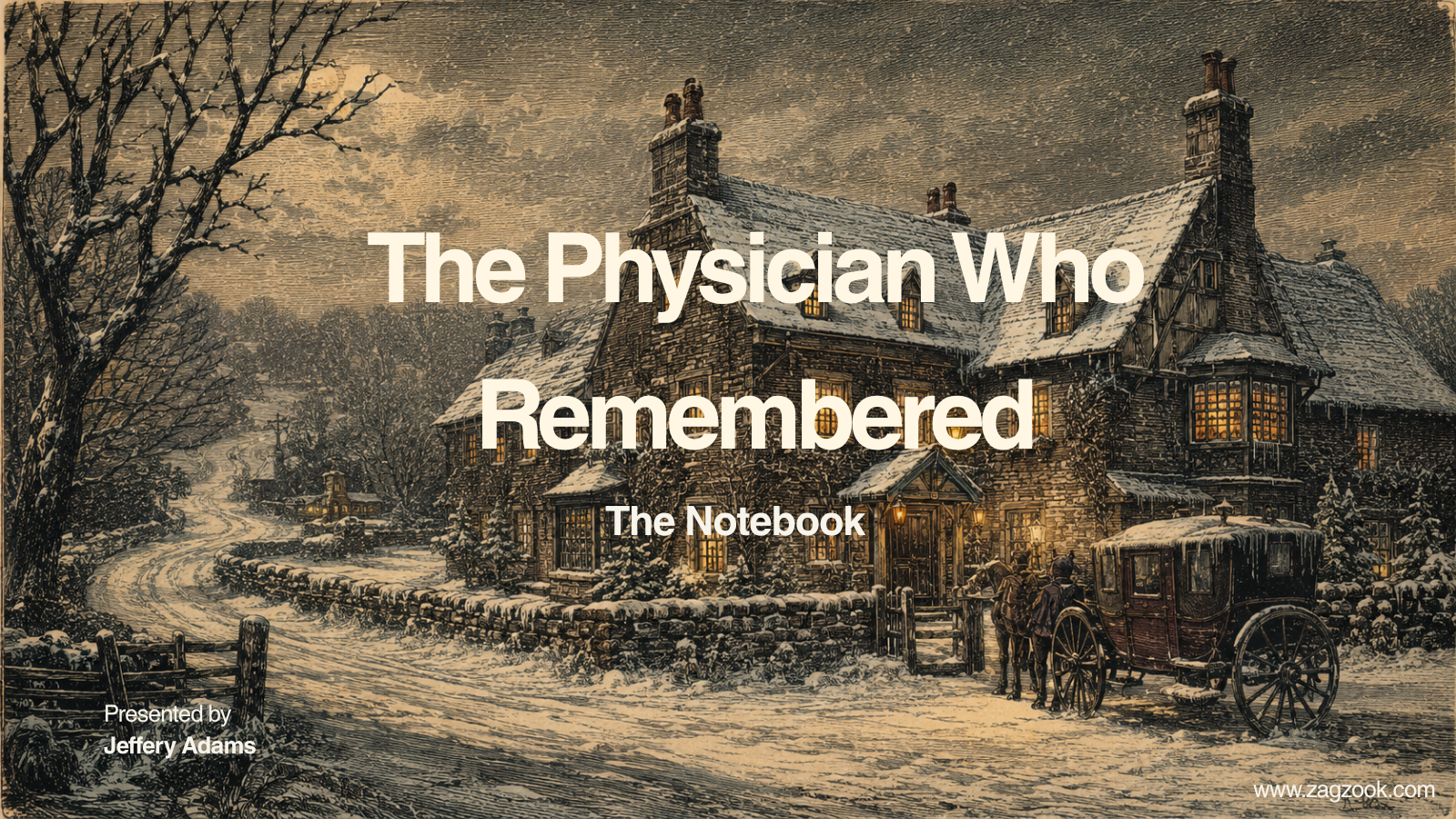
I had holly in my hands and pins in my mouth when Mrs. Bexley began screaming on the landing, so you may forgive me if this letter begins abruptly — there was no leisurely working-up to it, and I don't see why I should give you one you weren't afforded yourself.
Dr. Penn is dead. You'll remember me speaking of him — my father's oldest friend, the retired physician, on his way to his niece's for Christmas when this wretched snow closed the road and trapped the lot of us here at the Fenwick Arms. He was found this morning by the housemaid, Nell, quite peacefully in his bed, and the general verdict downstairs — arrived at with a speed I find almost indecent — is that his heart, which had troubled him for years, simply gave out in the night. Cold, excitement, an old man's constitution. Nobody here sees anything more in it than that, and I am aware that grief makes suspicious fools of the best of us, so you must judge whether I am being one.
I helped sort his effects this afternoon, at Mr. Bexley's asking, since someone had to make a list before the undertaker came and I could not bear the thought of a stranger's hands doing it. Among his things was the little notebook he always kept — you'll laugh, but he measured out his own heart-drops each night like a man balancing his household accounts, and wrote the dose down after, a habit from his working days, I suppose. The last page reads, in his own careful hand:
Dec. 19 — drops, 8 minims, as usual. Water fresh. Sleep early tonight — tired.
Eight minims. That was his figure every night I glanced at the book, going back a fortnight — never more, never less, the same fussy little ritual. I don't know why it should stick with me except that it is so entirely unlike a man about to die of anything sudden. But I am no physician, and perhaps that is precisely what a failing heart looks like on paper: ordinary, right up until it isn't.
The house is a strange mixture of hush and business as usual. Mr. Frayne — Edmund, Miss Calloway's intended, a solicitor with beautiful manners and a permanently anxious air about him even before this — sat up half the night at cards with Colonel Vane, or so I'm told, and has spent today snapping his watch-case open and shut in a way that would try anyone's nerves. Bexley himself, our host, has been jingling his keys and avoiding my eye since breakfast, which I put down to the strain of a death under his roof in the middle of his busiest season, though I confess I noted it.
And here is the small thing I almost didn't mention, because it is nothing, and yet it has lodged itself somewhere I can't dislodge it from. Going up rather late myself last night — the storm was making a fearful noise in the chimneys and I couldn't settle — I passed Miss Calloway on the guest-floor stairs, fully dressed still, though she'd told me at supper she meant to retire early with a headache. She said something about fetching a book she'd left in the parlour and went on down without waiting for me to answer. I thought nothing of it at the time. I'm not sure I think anything of it now. But you did once tell me that in your pamphlet-cases it's always the detail nobody thought worth mentioning that turns out to matter, and so I mention it, for what it's worth.
Tell me plainly — am I making a puzzle out of an old man's sad, ordinary end because I cannot bear for it to be ordinary? Or is there something in a fortnight of eight minims, never more, never less?
Yours, in the thick of it,
Purdie
P.S. — Nell tells me his water jug was still nearly full this morning, though his glass by the bed was almost dry. I don't know what that means either. Perhaps nothing.