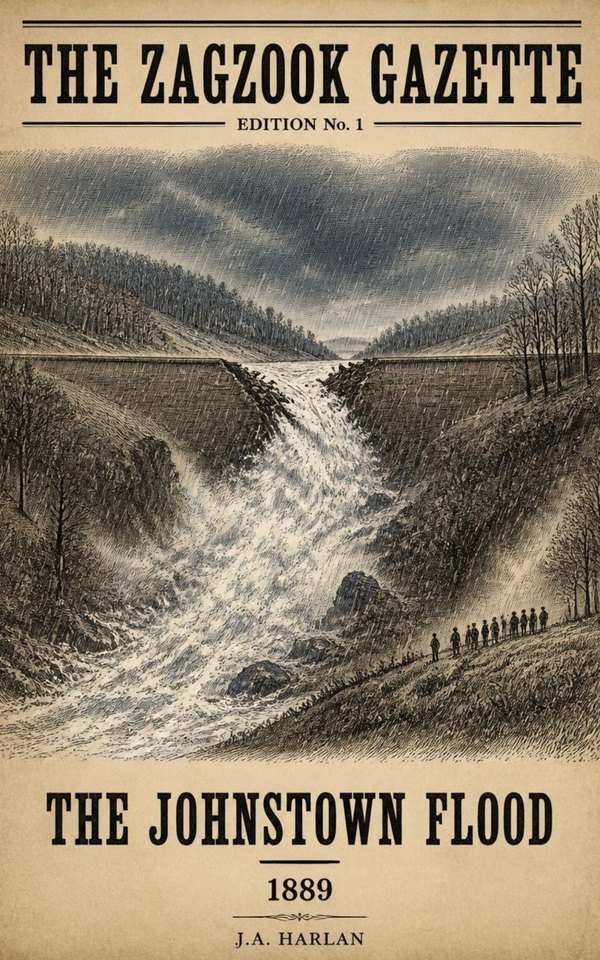
An imagined front page. The facts are from the historical record; the newspaper is not.
THE ZAGZOOK GAZETTE
Tuesday, June 4, 1889
SOUTH FORK DAM GIVES WAY; JOHNSTOWN SWEPT AWAY
Relief from Pittsburgh is held up at Sang Hollow. The Governor appeals to the nation.
JOHNSTOWN, Pa., June 4. The dam that held Lake Conemaugh in the hills above this valley gave way on Friday afternoon after days of heavy rain, and the lake poured down the Conemaugh valley into Johnstown. The town was already under water before the flood came. The rivers had been over their banks since the night before, and the streets of the lower town stood flooded through Friday morning while families moved their goods upstairs to wait for the water to go down.
The water from the lake came down the valley carrying trees, houses and railroad cars. It wrecked East Conemaugh and Woodvale on its way. At East Conemaugh it swept through the Pennsylvania Railroad’s yard, carrying off the roundhouse and its engines and overturning trains that stood on the tracks. It then struck Johnstown in the center and crossed the town to the South Side.
Below the town, houses and wreckage jammed against the railroad’s stone bridge over the Conemaugh. On Friday night the pile caught fire with people caught in it, while crowds on the hills above watched and could not reach them. The fire was still burning on Saturday.
Governor Beaver, in an appeal for help to the people of the United States, issued at Harrisburg yesterday, wrote: “The most conservative estimates place the loss of life at 5,000 human beings and of property at $25,000,000.” That figure is an estimate. The bodies are still being taken out of the ruins, and no list of the dead is complete.
Adjutant General D. H. Hastings reached the foot of Prospect Hill, opposite the railroad station, on Saturday evening after driving the whole way over roads deep in mud. On Sunday morning he crossed into the town and met with the sheriff and the burgess. At first they did not want troops brought in. On Sunday night they agreed to ask the Governor for them, and the Fourteenth Regiment has been sent for.
Railroad lines into the valley are broken in many places. Trains from Pittsburgh can come no closer than Sang Hollow, four miles below the town.
THE LAST MESSAGE FROM THE TELEGRAPH OFFICE
The Western Union office, in a frame building next to the Public Library on Washington Street, stayed open on Friday while the water rose through the morning. Its manager, Hettie Ogle, kept at her instrument and passed news of washouts and warnings about the South Fork dam to the operators at stations farther down the line. Friends urged her to leave. The office’s last message to the stations west was a short one: “This is my last message.” Soon afterward the wires from the town went silent.
RELIEF FROM PITTSBURGH
Early on Saturday morning a meeting at Old City Hall in Pittsburgh, called by the mayors of Pittsburgh and Allegheny, named a Citizens’ Relief Committee, which set to work while the meeting was still going on. Its relief train left Pittsburgh at four o’clock on Saturday afternoon and reached Sang Hollow at half past eight that night. Washouts and landslides stopped it there. James B. Scott commands the relief party. From Sang Hollow, food is being carried in on men’s shoulders or hauled the long way around over the hills.
SPECIAL OFFICERS SWORN IN
On Saturday afternoon Arthur J. Moxham called in 200 of his employees from the borough of Moxham, and they were sworn in as special officers to stop the robbing of the ruins. A citizens’ committee was chosen to help enforce the law. The liquor that could be found was poured out, and guards were posted.
Read the full story: The Zagzook Gazette, Edition No. 1: The Johnstown Flood by J.A. Harlan, in Kindle Unlimited.
Scan the code, or visit amazon.com/dp/B0HQ2DXW9P
Free front pages at zagzook.com/gazette/